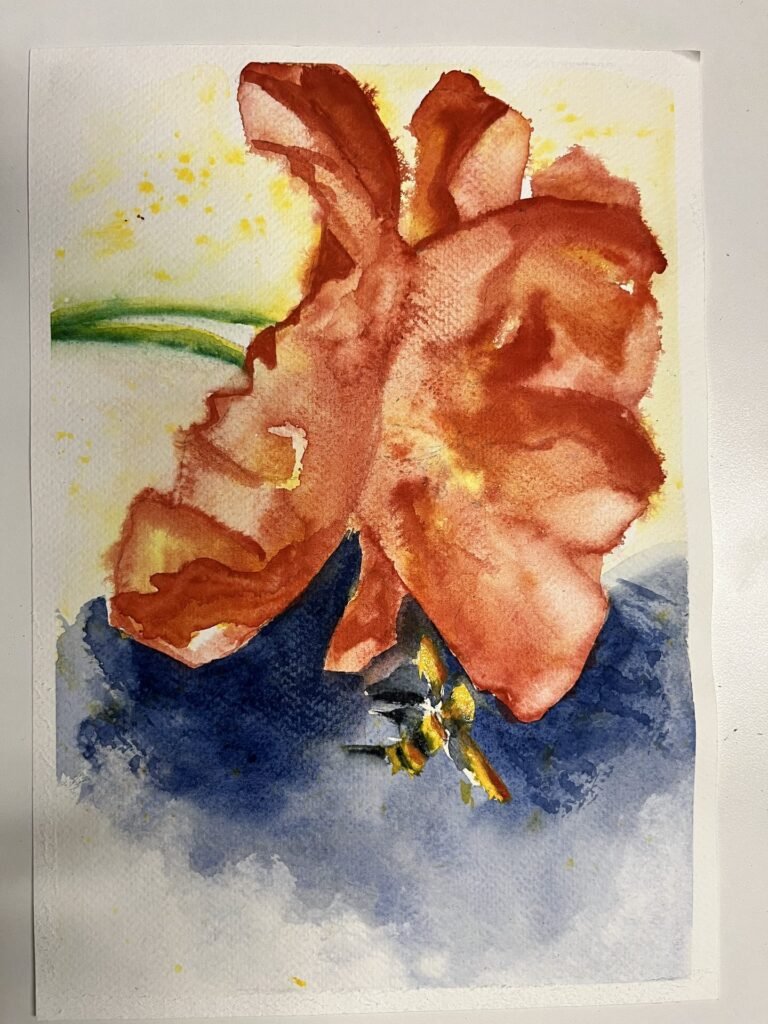
Your palette gets clogged. So does your brain. Here’s what to do about both.
There’s a very specific feeling when you’ve been painting for a while and you look down at your palette. What started as clean, distinct pools of colour — a cool white here, a warm ochre there, a strip of ultramarine blue along the top — has gradually become a muddy, churned-up mess. The colours have bled into each other. There’s no clean mixing space left. You keep reaching for fresh pigment but there’s nowhere to put it without making things worse.
So you do one of two things. You either abandon the session entirely, or you scrape the palette clean and start fresh.
I’ve been thinking about this a lot lately, because the same thing happens to my brain.
Not the muddy-paint version, exactly. But the principle is identical. Ideas accumulate. Projects start and don’t finish. Thoughts arrive while you’re in the shower and you carry them into the car and by the time you’ve got somewhere to write them down, three more have arrived on top of them. Soon enough, there’s no clean mixing space in your head either. Just a churned-up field of good intentions and unfinished things.
I’ve started calling this creative clog. Not creative block — that’s a different beast entirely. Block is empty. Clog is full.
The painting analogy is useful because it shows you how clog actually works at the technical level.
When you paint in oils on paper, the oil migrates through the surface almost immediately. That’s the nature of the medium — it wants to spread, to bleed outward, to claim territory. If you lay down too many layers before anything dries, you end up with a mess that no amount of working over will rescue. The individual marks that were going to build into something get lost in the accumulation.
But here’s the interesting thing: a good painter doesn’t fight this tendency. They work with it. They learn the rhythm — when to add, when to wait, when to scrape back to nothing and give the surface room to breathe.
This is exactly what I’ve had to learn with my own creative output.
I use white palettes for painting. Simple, cheap, easy to clean. When they get really clogged — and they do, especially when you’re working with a full range from cool whites round to warm earth tones — you can’t just pile more on. The mixing becomes unpredictable. Every new colour gets contaminated by what came before it.
The solution isn’t complicated. You clean the palette. You create space. Then you can work cleanly again.
The creative version of this is harder, because you can’t scrape your brain clean the way you can scrape a palette. But you can externalise.
This is the one insight that’s changed how I work more than anything else: get the ideas out of your head and into some external form. Voice memos. Morning pages. A WhatsApp message to yourself at 7am on a dog walk. A notebook that lives by the kettle. It doesn’t matter which. What matters is the act of externalisation — moving the thought from the crowded internal palette to somewhere it can exist without contaminating everything else.
The voice memos are where I do most of this. I’ve been recording my thinking while walking — 7km loops, most mornings, Cornwall being reliably grey and windy and exactly what you need when you’re trying to clear your head. I talk through whatever’s jamming up the palette. Problems I’m chewing on. Ideas for the course I’m building. Things I’ve been reading that connected to things I’ve been doing. The whole slightly disorganised stream of it.
And what I’ve discovered, somewhat belatedly, is that this archive of recordings is a goldmine. Not because every thought in there is brilliant — most of them are half-formed and a bit rambling. But because the act of recording them cleared space. They left the palette. Now there’s room to mix something new.
This is what a creative practice actually requires, I think. Not just the making — the painting, the teaching, the writing — but the regular maintenance. The scraping back. The clearing of space so the next thing can be clean.
The pressure you feel when you’re creatively clogged isn’t a sign that you’re running dry. It’s usually the opposite. It’s a sign that there’s too much in there and none of it can get out.
The fix isn’t to try harder. It’s to move more of what’s in there to somewhere else, so your brain can stop trying to hold it all and start doing something useful with it.
Pick your medium for externalisation — voice, pen, keyboard, conversation. Start using it daily, before the palette gets to critical mass. And when it does anyway, don’t abandon the session. Just scrape it clean and start fresh.
The paint is still good. The ideas are still there. You’ve just created some space to work with them properly.
If you’re finding yourself with too many ideas and too little actual output, that’s the clog speaking. The next step isn’t to generate more ideas — it’s to release the ones you’re already carrying. Start with five minutes and a voice memo on your morning walk. See what surfaces.
CP52 Stage: Stage 4 — The Work (doing the creative work daily)
Series: The Creative Clog Series
Image note: A well-used artist’s palette — not pristine, not ruined. The beautiful mess of someone in the middle of work.
