Success is freedom. Getting there requires being honest about the maths.
There’s a conversation that comes up in every teaching context I’ve been part of, sooner or later.
Someone is doing genuinely good work. They love it. They’re skilled at it. Their students or clients or audience are getting real value from it. And they’re not making enough money from it to sustain the life around it.
The conversation usually surfaces with a specific flavour of exhaustion — not the exhaustion of hard work, which is bearable, but the exhaustion of hard work that isn’t adding up.
I’ve been that person. I recognise the exhaustion.
The in-person teaching model, at its best, is a beautiful thing. Students in a physical space, learning from someone who is present and responsive, building skills and confidence in real time, forming the kind of community that can only happen when people are physically together.
But the economics of it require attention, because they are easy to misread.
When I look honestly at what in-person teaching costs — room hire, heat and light, refreshments (because hospitality matters, but coffee and cake add up), materials, setup and clean-down time, the planning and preparation that doesn’t appear in any session invoice — the margin on a day of teaching is considerably thinner than it appears.
Maximum students. Twice a day. Margins taken by the infrastructure.
This is not a reason to stop teaching in person. It’s a reason to understand that in-person teaching, however much you love it, is not the growth lever if what you’re trying to build is a sustainable creative income.
The growth lever is online.
I know this isn’t news. The pivot to online teaching has been the story of the creative education sector for several years now. But knowing the direction and actually building toward it are different things, and I want to be honest about what the building requires.
It requires a different kind of patience from in-person teaching.
In-person, the feedback loop is immediate. You show up, you deliver, people respond, you get paid, you can see the value you created in the faces of the people in the room. The cycle is short and the signals are clear.
Online, the feedback loop is longer. You build something. You put it out. You wait. You iterate. The signals are harder to read in the early days — low numbers don’t necessarily mean low quality, they can mean low reach. You’re building an audience before you can convert an audience, and building an audience takes time.
This requires building financial runway to operate in that patience period. And it requires being honest with yourself about what the target is and what it would take to hit it.
Here’s the version of the maths that’s been clarifying for me:
In-person teaching has a ceiling. The ceiling is set by the number of students you can physically be in a room with, the number of sessions you can deliver in a week, and the margin left after the real costs are deducted. You cannot teach more people than can fit in the room. You cannot teach more sessions than you have time for.
Online teaching has a different ceiling — much higher, potentially uncapped depending on the model — but it requires front-loading. You invest time and money and effort in creating something before you see any return from it.
The transition period — when you’re still running the in-person operation while also building the online one — is the hardest. You’re running two things simultaneously, neither of them getting your full attention, the in-person generating most of the current income while the online is consuming most of the current energy.
There is no clean way through this period. You just have to be in it, keep the in-person going well enough to generate cash flow, and keep building the online with whatever time and energy remains.
The phrase I keep returning to is: success is freedom.
Not freedom from work. Freedom through work. The specific freedom that comes from being able to earn from what you love, in a way that is sustainable and scalable and not dependent on you being physically in a particular room at a particular time.
That’s the goal. Not wealth in the abstract. Not maximum revenue. Freedom: to choose the work, to choose the pace, to choose who you serve and how, without the constraints of a model that requires your physical presence to function.
The online infrastructure — the courses, the community, the email list, the content that works while you sleep — is the path to that freedom. It’s not quick. But it is logical, and it is buildable, and people who have done it from a standing start are not some special category of person. They just started before they felt ready, kept going through the patchy early period, and compounded the effort long enough for the compound interest to kick in.
I’m in the patchy early period.
The teaching is there. The material is real. The audience is forming, slowly. The infrastructure is being built, piece by piece, with occasional significant errors (see: the £120 AI bill) and gradual learning.
The maths is becoming clearer. Not comfortable yet, but clearer. I can see what the target looks like. I can see what it would take to hit it. I can see that the gap between here and there is not unbridgeable.
It requires staying honest about the numbers. It requires not romanticising the in-person at the expense of building the online. It requires keeping going through the period where the effort isn’t yet showing up in the results.
And it requires knowing what you’re building toward.
Freedom. Through work that matters, in a form that scales, on terms you’ve chosen.
That’s what makes the maths worth doing.
If you’re trying to build a sustainable creative income, the most important thing you can do right now is get honest about the actual economics of what you’re currently doing. Not the gross numbers — the net. What does a day of in-person teaching actually cost you, all in? What would it take to replace that income with something that doesn’t require your physical presence every time? Start with the numbers. The direction will become clearer.
CP52 Stage: Stage 6 — The Income (making it sustainable)
Series: Making It Work Online
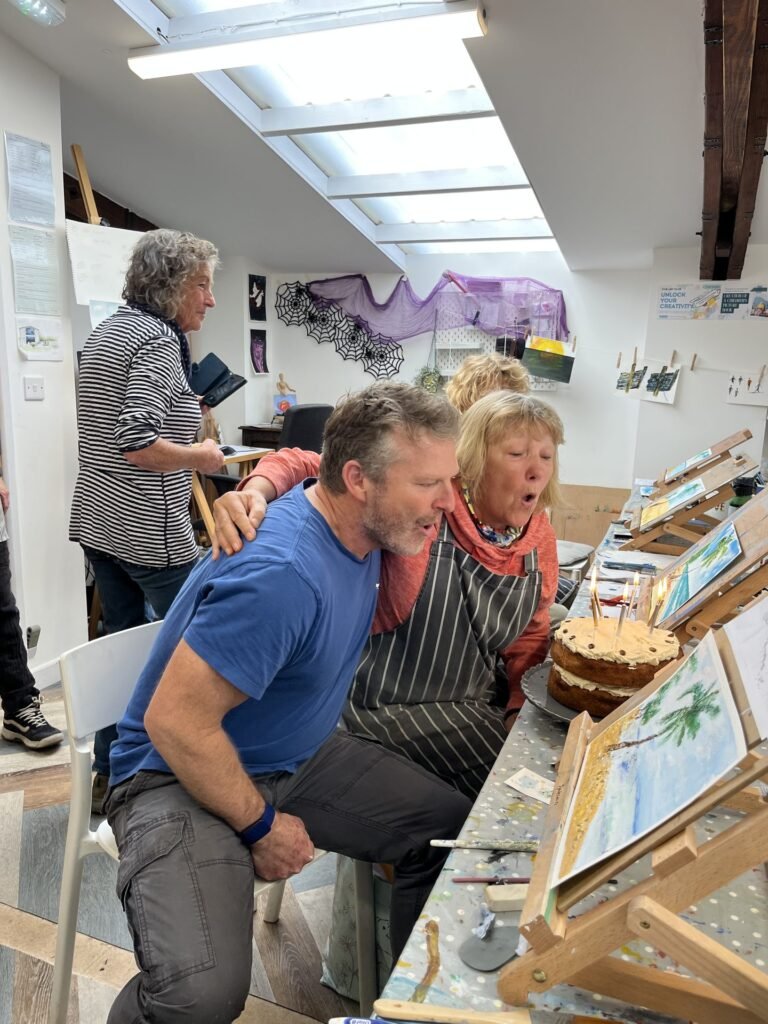
Image note: A teaching room, beautiful and small — and next to it, a laptop open to a course platform. The two models, side by side.
